In critical care/emergency situations, there is a moment when the usual transport facility and treatment provided reach their limits. In various cases, ventilators are maximized, medications are escalated, and even after the medical team has done everything possible, the patient’s condition keeps failing. That is the moment when ECMO is not a choice but a necessity to save an individual’s life.
For many families, this moment is overwhelming, and for doctors, it is decisive. The reason being it is an emergency situation; it is a race against time that requires quick decision-making but not panic.
If you are someone from Ajman or across the UAE, you might be aware that such situations demand more than advanced technology. A lot of remote area accidents demand a system capable of moving life support itself, safely and without interruption. This is where ECMO transfer UAE operations become an important point of transfer with intensive care. This is not simply transport but continuity of life-sustaining treatment from one ICU to another. A lot of times it is across cities, borders, or countries as well.
At ICATT, we take ECMO transfers very seriously, and they’re managed as controlled clinical missions, where aviation, medicine, and logistics function as one coordinated unit.
Understand how ECMO transfers work in Ajman, what families and hospitals should expect, and how air medical systems actually helps patients remain stable from takeoff to transfer at a new medical facility using air ambulance in Ajman and broader air ambulance UAE networks.
Understanding ECMO: Why Transfer Is Often Required
ECMO (Extracorporeal Membrane Oxygenation) is one of the most advanced forms of life support systems on the market today. It temporarily takes over the function of the heart and/or lungs, allowing these organs to rest, heal, and recover.
There are two primary forms:
- VV-ECMO for severe respiratory failure
- VA-ECMO for cardiac or combined heart–lung failure
Although a number of hospitals in the UAE can initiate ECMO, not all facilities are prepared to offer long-term ECMO management, advanced cardiac surgery, transplant care, or specialized recovery protocols. This results in patients being transferred urgently and safely to higher-level medical centers.
This requirement often occurs in Ajman when patients must be moved to specialized hospitals in Dubai, Abu Dhabi, or anywhere else internationally.
Why ECMO Transfers Are Different from Regular Air Ambulance Missions
Transporting a patient on ECMO is not comparable to ventilated or ICU-level transfers. The margin for error is virtually zero.
An ECMO patient is dependent on:
- Continuous blood circulation outside the body
- Constant oxygenation and carbon dioxide removal
- Stable anticoagulation
- Highly sensitive equipment that must function without interruption
Any disruption, power failure, vibration instability, tubing displacement, or physiological imbalance can be catastrophic.
At ICATT, ECMO transport is treated as a mobile extension of the ICU, not as a flight.
When ECMO Transfers Are Required in Ajman
ECMO transfers are typically initiated in cases such as:
- Severe ARDS unresponsive to ventilation
- Cardiogenic shock after massive heart attack
- Fulminant myocarditis
- Post-cardiac surgery failure
- Severe COVID-related lung injury
- Huge pulmonary embolism
- Helps in Bridge-to-transplant or bridge-to-recovery cases
In any of these above-mentioned situations, delay is never an option. Once a patient is stabilized on ECMO, only then does the transfer planning begin.
How ECMO Transfers Work in Ajman: Step-by-Step
- Case Referral and Immediate Medical Review
The process begins with a call from the treating hospital or family. ICATT’s ECMO coordination team immediately reviews:
- Diagnosis and clinical status
- ECMO mode and duration
- Hemodynamics and ventilation parameters
- Imaging and laboratory reports
This step is majorly important to determine whether the patient is stable enough for transport or not and what advanced resources are required to keep the condition stable.
- Deployment of the ECMO Retrieval Team
If required, ICATT deploys a specialized ECMO retrieval team to the referring hospital in Ajman. This team typically includes:
- ECMO-trained intensivist
- Perfusionist
- Critical care specialist nurse (male/female)
- Aeromedical coordinator
In case ECMO has not yet been initiated at this point, the team can cannulate and stabilize the patient on-site before transfer. This ensures avoiding risk while transferring.
- Aircraft Selection and Configuration
For ECMO transfers, fixed-wing aircraft are preferred due to:
- Cabin space for ECMO consoles
- Ability to carry redundant oxygen supplies
- Stable flight conditions
- Long-range capability
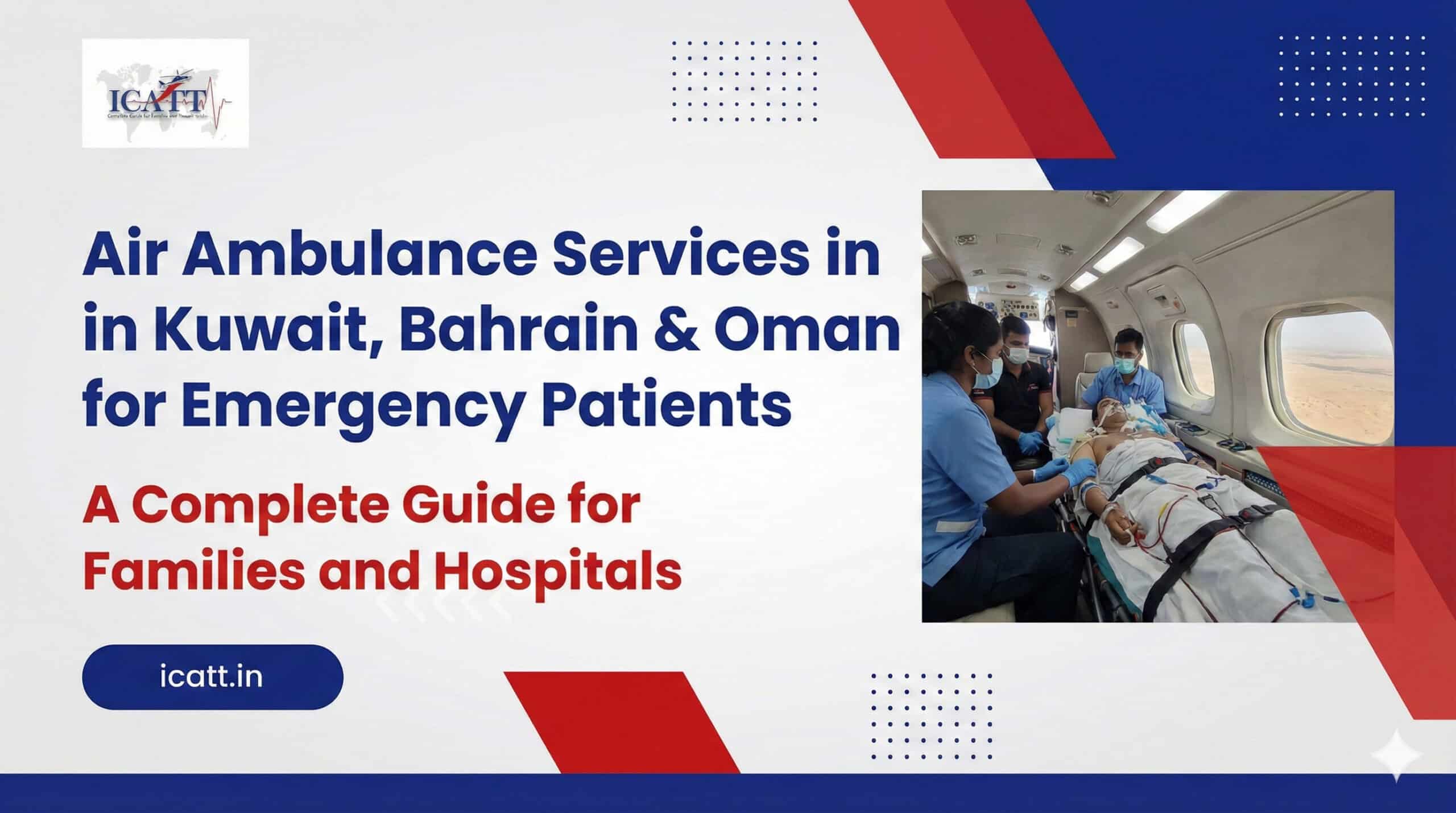
The aircraft is converted into a flying ICU with:
- ECMO machine securely mounted
- ICU ventilator and monitors
- Infusion pumps
- Backup power systems
- Shock-absorbing stretcher systems
This configuration is standard for Air Ambulance in Ajman ECMO missions operated by ICATT.
- Ground-to-Air Complete Coordination
Ground ambulances are synchronized on both ends like:
- ICU ambulance from hospital to airport
- Direct ramp access wherever possible
- Minimal handover time
Every movement is timed to avoid delays and reduce patient exposure.
- In-Flight ECMO Management
During flight, the medical team continuously manages:
- ECMO flow and oxygenation
- Blood pressure and cardiac output
- Anticoagulation levels
- Ventilation parameters
- Metabolic and acid-base balance
Real-time communication is maintained with the receiving hospital so that the ICU team is fully prepared on arrival.
- Arrival and ICU Handover
Upon landing, the patient is transferred directly to the receiving ICU. A structured clinical handover includes:
- ECMO settings and trends
- Medications administered
- Events during transport
- Ongoing risks and recommendations
This ensures continuity of care without information loss.
Why Air Ambulance Is Essential for ECMO Transfers
Road transport is not suitable for ECMO patients over long distances due to:
- Vibration risks
- Limited space for equipment
- Traffic delays
- Oxygen constraints
Only Air ambulance UAE services with ECMO capability can provide:
- Speed
- Stability
- Controlled clinical environments
- International transfer options
In critical ECMO cases, air transport is not a premium choice, it is a medical necessity.
What are the Key Challenges in ECMO Transfers and How ICATT Manages Them
Clinical Instability: Managed through continuous monitoring, onboard interventions, and experienced decision-making.
Equipment Failure: Prevented by carrying backup ECMO circuits, power supplies, and oxygen systems.
Regulatory and Clearance Delays: Handled by ICATT’s dedicated aviation and international clearance team.
Family Anxiety: Addressed through transparent communication and regular updates.
Hospitals and Referral Networks Supported from Ajman
ICATT frequently coordinates ECMO transfers from Ajman to:
- Advanced cardiac centers in Dubai
- Quaternary ICUs in Abu Dhabi
- International transplant and ECMO centers
Coordination includes ICU bed confirmation, specialist availability, and seamless admission.
Why ICATT Is Trusted for ECMO Transfers in the UAE
ICATT’s ECMO transport program is built on clinical governance, not convenience.
What Sets ICATT Apart
- ECMO-trained professionals for managing complexity
- Professionals have proven experience in complex aeromedical retrievals
- Aircraft designed for critical care missions
- International ECMO transfer capability
- Strict adherence to global safety protocols
ICATT ensures every ECMO transfer is approached as a medical mission, not a logistics task.
For Families: What to Expect During an ECMO Transfer
Families are supported throughout the process with:
- Clear explanations of risks and timelines
- Transparent cost structures
- Continuous status updates
- Dedicated coordination support
ICATT understands that behind every ECMO transfer is not just a patient, but a family waiting for hope.
ECMO Transfers Are About Precision, Not Speed Alone
In Ajman, ECMO transfers represent the highest level of critical care coordination. Every case is different, which is why it demands proven experience, clinical judgment, and seamless execution to avoid any kind of risk. Therefore, when a transfer is being done, specialized teams, ICU-configured aircraft, and disciplined protocols are followed properly. The ICATT team ensures they give patients the chance to survive and deliver ECMO transfers that preserve life, stability, and dignity across Ajman, the UAE, and beyond. ICATT is one of the most trusted air ambulances in Ajman and air ambulance UAE networks, so for hospitals and families facing the most critical moments, ECMO transfer is not just about reaching another ICU. It is about ensuring that life support never stops, even for a second.